This academic CV template gives you a complete postdoctoral CV as text you can copy, with numbered publications and your name in bold in every author list. The layout is called Scholar, and the sample is a marine ecologist applying for lectureships. A4 · 2–4 pages.
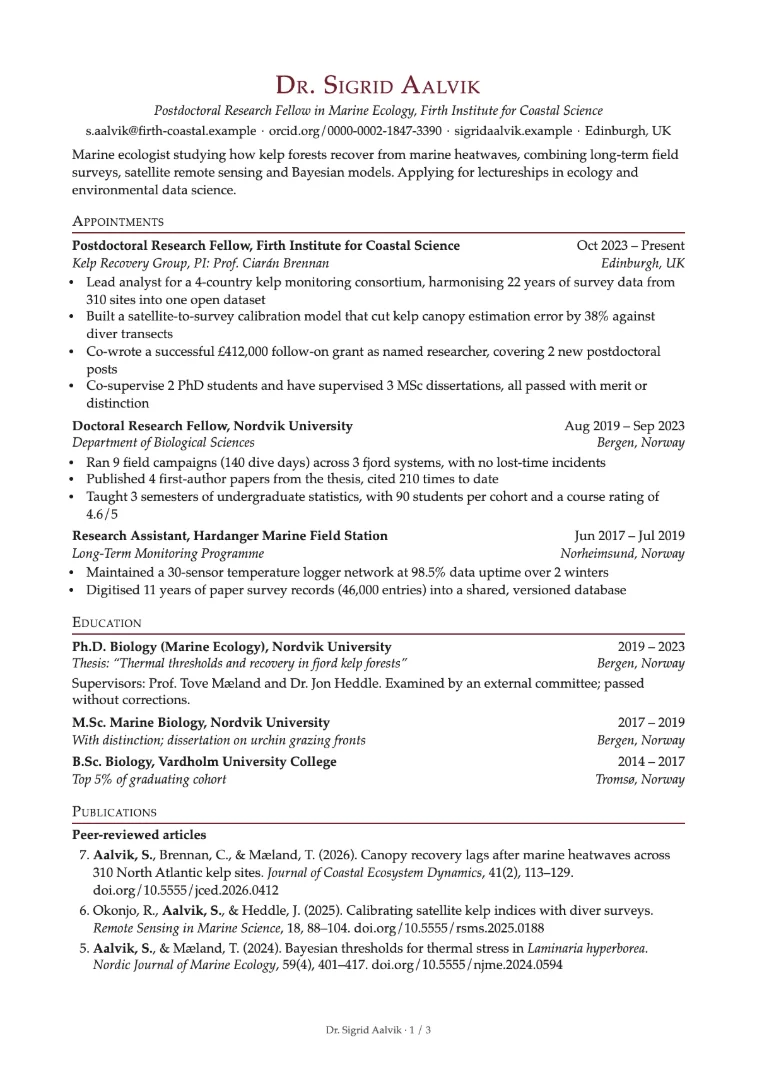
First page of the sample as the Scholar template prints it: Dr. Sigrid Aalvik, Postdoctoral Research Fellow in Marine Ecology, Firth Institute for Coastal Science
What goes in an academic CV?
Your appointments, degrees, publications, grants, talks, teaching, supervision and service, with referees at the end. The sample also gives data sets and software their own section as research outputs.
Number publications newest first and bold your own name in each author list.
Keep peer-reviewed articles apart from preprints and work in review.
Give each grant its amount, length and your role, such as named researcher on a £412,000 award over 3 years.
Count teaching and supervision: cohort sizes, PhD students co-supervised and MSc dissertations supervised.
Put the group, the PI and the place on the line under each appointment.
List referees with their affiliation and email at the end. The sample keeps them in one variable.
Academic CV example, in full
Dr. Sigrid Aalvik is a made-up person: the name, employers, schools and contact details are invented to show how the layout reads when it is full. Copy the Markdown, then replace the words with yours.
Dr. Sigrid Aalvik
Postdoctoral Research Fellow in Marine Ecology, Firth Institute for Coastal Science
s.aalvik@firth-coastal.example
orcid.org/0000-0002-1847-3390
sigridaalvik.example
Edinburgh, UK
Marine ecologist studying how kelp forests recover from marine heatwaves, combining long-term field surveys, satellite remote sensing and Bayesian models. Applying for lectureships in ecology and environmental data science.
Appointments
Postdoctoral Research Fellow, Firth Institute for Coastal Science Oct 2023 – Present
Kelp Recovery Group, PI: Prof. Ciarán Brennan Edinburgh, UK
Lead analyst for a 4-country kelp monitoring consortium, harmonising 22 years of survey data from 310 sites into one open dataset
Built a satellite-to-survey calibration model that cut kelp canopy estimation error by 38% against diver transects
Co-wrote a successful £412,000 follow-on grant as named researcher, covering 2 new postdoctoral posts
Co-supervise 2 PhD students and have supervised 3 MSc dissertations, all passed with merit or distinction
Doctoral Research Fellow, Nordvik University Aug 2019 – Sep 2023
Department of Biological Sciences Bergen, Norway
Ran 9 field campaigns (140 dive days) across 3 fjord systems, with no lost-time incidents
Published 4 first-author papers from the thesis, cited 210 times to date
Taught 3 semesters of undergraduate statistics, with 90 students per cohort and a course rating of 4.6/5
Research Assistant, Hardanger Marine Field Station Jun 2017 – Jul 2019
Maintained a 30-sensor temperature logger network at 98.5% data uptime over 2 winters
Digitised 11 years of paper survey records (46,000 entries) into a shared, versioned database
Education
Ph.D. Biology (Marine Ecology), Nordvik University 2019 – 2023
Thesis: “Thermal thresholds and recovery in fjord kelp forests” Bergen, Norway
Supervisors: Prof. Tove Mæland and Dr. Jon Heddle. Examined by an external committee; passed without corrections.
M.Sc. Marine Biology, Nordvik University 2017 – 2019
With distinction; dissertation on urchin grazing fronts Bergen, Norway
B.Sc. Biology, Vardholm University College 2014 – 2017
Top 5% of graduating cohort Tromsø, Norway
Publications
Peer-reviewed articles
Aalvik, S., Brennan, C., & Mæland, T. (2026). Canopy recovery lags after marine heatwaves across 310 North Atlantic kelp sites. Journal of Coastal Ecosystem Dynamics, 41(2), 113–129. doi.org/10.5555/jced.2026.0412
Okonjo, R., Aalvik, S., & Heddle, J. (2025). Calibrating satellite kelp indices with diver surveys. Remote Sensing in Marine Science, 18, 88–104. doi.org/10.5555/rsms.2025.0188
Aalvik, S., & Mæland, T. (2024). Bayesian thresholds for thermal stress in Laminaria hyperborea. Nordic Journal of Marine Ecology, 59(4), 401–417. doi.org/10.5555/njme.2024.0594
Heddle, J., Aalvik, S., Lindqvist, E., & Mæland, T. (2023). Diver transects versus drop cameras for estimating kelp density. Remote Sensing in Marine Science, 16, 211–226. doi.org/10.5555/rsms.2023.0162
Aalvik, S., Heddle, J., & Mæland, T. (2023). Urchin grazing and fjord temperature gradients. Journal of Coastal Ecosystem Dynamics, 38(1), 22–37. doi.org/10.5555/jced.2023.0381
Aalvik, S., & Mæland, T. (2022). Winter temperature loggers reveal hidden thermal stress in sheltered fjords. Nordic Journal of Marine Ecology, 57(2), 140–152. doi.org/10.5555/njme.2022.0572
Aalvik, S., Mæland, T., & Sørbø, K. (2021). Recruitment of Laminaria hyperborea after canopy loss in three Norwegian fjords. Journal of Coastal Ecosystem Dynamics, 36(3), 301–315. doi.org/10.5555/jced.2021.0363
Preprints and in review
Aalvik, S., Okonjo, R., & Brennan, C. (in review). Forecasting kelp canopy loss from sea-surface temperature anomalies. Journal of Coastal Ecosystem Dynamics.
Aalvik, S., & Brennan, C. (preprint, 2025). A shared protocol for multi-decade kelp survey harmonisation. doi.org/10.5555/preprint.2025.1107
Data & software
Harmonised North Atlantic kelp survey dataset: 310 sites, 1.2 million records, 1998–2024, CC BY 4.0. doi.org/10.5555/data.2025.0310 (downloaded 1,400 times)
kelpcal, an R package for calibrating satellite kelp indices against diver surveys, 3 releases, used by 5 research groups. github.com/saalvik/kelpcal
Field protocol and logger firmware settings for winter temperature monitoring, adopted by 2 field stations. doi.org/10.5555/protocol.2022.0045
Grants & funding
Named researcher, Coastal Resilience follow-on grant 2025 – 2028
£412,000 over 3 years; co-written with the PI Firth Institute for Coastal Science
Early Career Travel Award 2024
£2,500 for a 6-week research visit on satellite calibration Firth Institute for Coastal Science
Doctoral fellowship 2019
Fully funded, 4 years, including a 10% teaching duty Nordvik University
Invited talks & conference presentations
Invited seminar: “What 22 years of kelp surveys say about heatwave recovery”, Scottish marine science seminar series, Oban (2026)
Session opener: “Canopy recovery lags after marine heatwaves”, European ecology congress, Lisbon (2025)
Science-for-policy briefing on kelp harvesting limits to a regional fisheries board, Edinburgh (2024)
Contributed talk: “Calibrating satellite kelp indices with diver surveys”, international remote sensing of coasts symposium, Brest (2024)
Contributed talk: “Thermal thresholds in fjord kelp”, North Atlantic benthic ecology workshop, Galway (2023)
Contributed talk: “Urchin fronts and winter temperature”, Nordic ecology society annual meeting, Uppsala (2022)
Remote sensing and GIS: Python (xarray, rasterio), Google Earth Engine, QGIS
Fieldwork: scientific diving (HSE Part IV equivalent, 600+ logged dives), small-boat handling, logger deployment
Languages: Norwegian (native), English (C2), Swedish (C1, receptive)
References
Prof. Ciarán Brennan, Firth Institute for Coastal Science (c.brennan@firth-coastal.example) · Prof. Tove Mæland, Nordvik University (tove.maeland@nordvik-uni.example) · Dr. Ruth Okonjo, Firth Institute for Coastal Science (r.okonjo@firth-coastal.example)
How the Scholar layout is built
An old-style serif with a centered small-caps name
Numbered publications with your name in bold
Your name and page number in the footer, which you can change in Settings
A4, two to four pages, with one reading order for university application systems
Researchers, postdocs and early-career faculty, for example:
Postdoctoral researchers
Early-career faculty and lecturers
PhD candidates applying for fellowships and research posts